
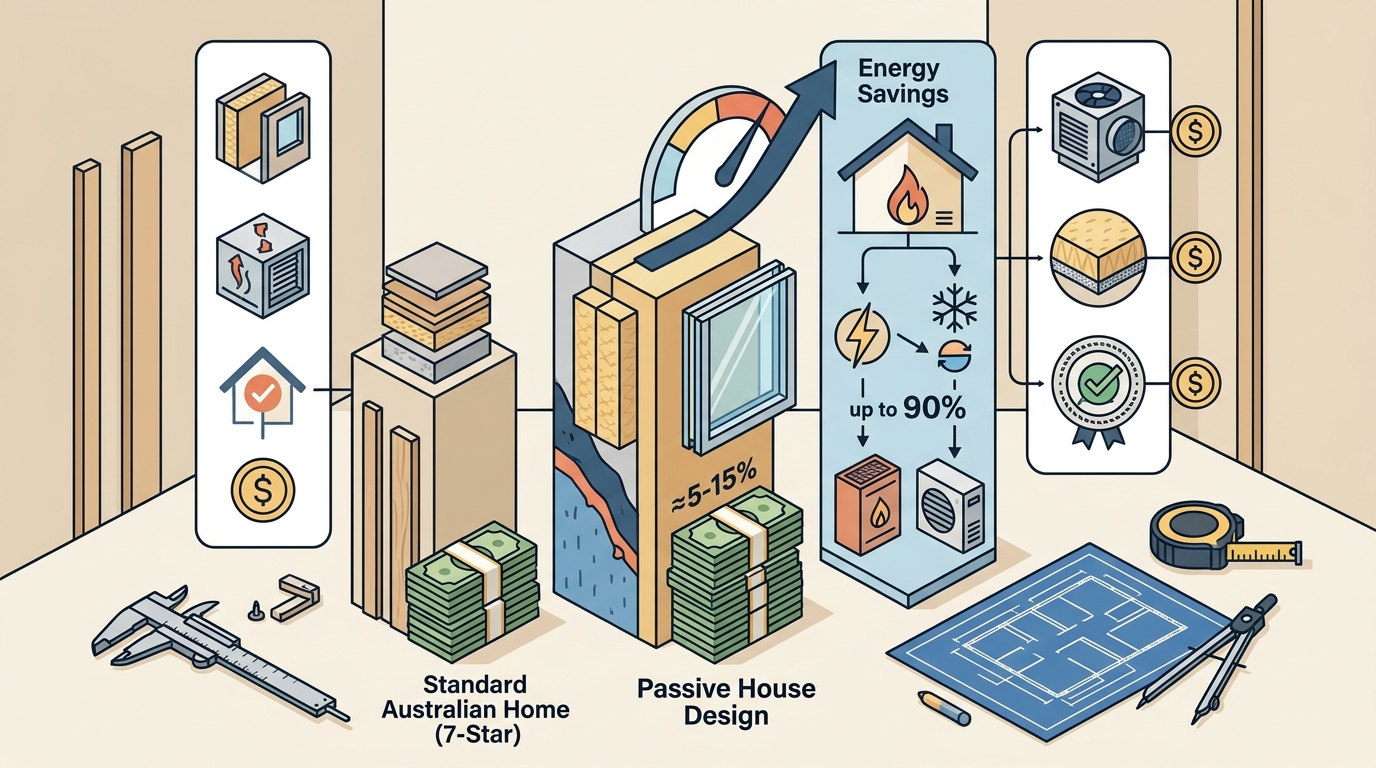
Passive House design in Australia typically costs 5% to 15% more upfront than a standard 7-star home. This premium buys a building that uses up to 90% less energy for heating and cooling. This guide breaks down the exact cost drivers, from component pricing to certification fees, so you can budget accurately.
High Performance Components
High performance components are the physical elements that make a Passive House work. These include triple-glazed windows, high-grade insulation, and mechanical ventilation with heat recovery. In a standard home, you might use double glazing and basic insulation. In a Passive House, the specification is significantly higher to ensure airtightness and thermal stability.
Windows are often the most expensive line item. A standard double-glazed window might cost a certain amount, but a certified Passive House window with low U-values and high solar heat gain coefficients costs more. However, the price gap has narrowed as supply chains mature. At reimagined habitat, we specify components that balance cost with performance. We do not just buy the most expensive option; we model the building to find the cost-optimal solution.
Ventilation is another key area. A standard home relies on natural drafts or basic exhaust fans. A Passive House uses a heat recovery ventilation system. This unit recovers heat from the exhaust air and transfers it to the fresh air coming in. This prevents energy loss while maintaining indoor air quality. The upfront cost is higher, but the long-term savings are significant.
Energy Bill Savings
Energy bill savings are the primary financial return on a Passive House investment. In a typical Australian home, heating and cooling account for about 40% of energy use. A Passive House cuts this demand by up to 90%. This means your energy bills drop dramatically. You are no longer paying to fight your house; you are paying for a house that holds its temperature.
The savings depend on your climate and your baseline. If you are replacing an old, draughty home, the savings are massive. If you are comparing a Passive House to a new 7-star home, the savings are still significant but smaller. The key is that the savings are predictable. Because the building envelope is airtight and well-insulated, the energy demand is stable year-round. This predictability helps with budgeting and financial planning.
Over a 30-year ownership period, the energy savings can offset the upfront premium. This is the payback period. It is not just about money; it is about comfort. A Passive House is comfortable in winter and summer without relying on high-energy heating or cooling systems. This comfort has a value that is hard to quantify but easy to feel.
Upfront Cost Premium
The upfront cost premium is the extra money you pay to build a Passive House compared to a standard home. In Australia, this premium is usually between 5% and 15%. This range is not arbitrary; it reflects the cost of better components and more rigorous construction. The lower end of the range applies when Passive House principles are integrated early in the design process. The higher end applies when they are added late as an afterthought.
It is important to compare like with like. A standard new home in Australia must meet a 7-star NatHERS rating. This already requires better glazing and insulation than homes built a decade ago. So you are not comparing a Passive House to a cheap home; you are comparing it to a good one. The gap is smaller than people assume. When you factor in the energy savings, the total cost of ownership is often lower for a Passive House.
The premium also depends on the size and complexity of the home. A simple, boxy design is cheaper to make airtight than a complex design with many corners and penetrations. At reimagined habitat, we work with clients to design homes that are both beautiful and cost-effective. We use the Passive House Planning Package to model different scenarios and find the most efficient solution.
Certification Fees
Certification fees are the costs associated with getting your home officially certified as a Passive House. This includes the cost of the Passive House Planning Package (PHPP) modelling and the certification process itself. The PHPP is a software tool that models the building's energy performance. It is the standard tool used for Passive House certification. The cost of the modelling is usually a small fraction of the total build cost.
Certification also involves an airtightness test. This test is done after the building envelope is complete but before the interior finishes are installed. It measures how airtight the building is. If the building fails the test, it must be fixed and retested. This is why airtightness is a critical part of the construction process. The cost of the test is relatively low, but the value is high. It ensures that the building performs as designed.
Some people choose to build to Passive House principles without getting certified. This can save on certification fees, but it also means you do not have the guarantee of performance. Certification is a quality check. It ensures that the building meets the rigorous standards of the Passive House Institute. For many homeowners, this peace of mind is worth the fee.
Early Integration
Early integration is the practice of incorporating Passive House principles into the design phase from the very beginning. This is the single most important factor in keeping the cost premium low. When you start with a standard design and try to make it a Passive House later, you often have to make expensive changes. For example, you might need to add more insulation or change the window specifications. These changes can be costly and disruptive.
When you start with Passive House principles, the design is optimized for performance from the start. This means you can choose components that are cost-effective and efficient. It also means that the construction process is smoother. The builder knows exactly what to do and how to do it. This reduces the risk of errors and rework. At reimagined habitat, we recommend running the calculations early in the design process. The earlier performance is baked in, the cheaper it is to achieve.
Early integration also allows for design flexibility. You can explore different layouts and orientations to find the best balance between performance and aesthetics. This is not possible if you try to retrofit Passive House principles into an existing design. The result is a home that is both beautiful and high-performing. It is a win-win for the homeowner and the environment.
Construction Cost Premium
The construction cost premium is the extra cost of building a Passive House compared to a standard home. This premium is driven by the need for precision and attention to detail. A Passive House must be airtight, which means that every joint and penetration must be sealed. This requires skilled labor and careful supervision. It is not enough to just install the right components; they must be installed correctly.
The premium also reflects the cost of quality control. A Passive House builder must follow a strict set of guidelines to ensure that the building meets the certification standards. This includes regular inspections and testing. The cost of this quality control is higher than for a standard home, but it is necessary to ensure that the building performs as designed. The result is a home that is built to last and performs reliably.
It is worth noting that the construction cost premium is not just about money; it is about value. A Passive House is a high-quality product. It is built with better materials and more skilled labor. This means that it is more durable and requires less maintenance over time. The long-term value of a Passive House is higher than that of a standard home. This is an important factor to consider when making your decision.
Key Takeaways
- The upfront cost premium for a Passive House in Australia is typically 5% to 15%.
- Energy bill savings can offset the upfront premium over a 30-year period.
- Early integration of Passive House principles is the key to keeping costs low.
- Certification fees are a small fraction of the total build cost but provide valuable peace of mind.
- High performance components like triple-glazed windows and heat recovery ventilation are essential.
- The construction cost premium reflects the need for precision and quality control.
- A Passive House is a high-quality product that is more durable and requires less maintenance.
- Comparing a Passive House to a standard 7-star home shows a smaller gap than comparing it to an older home.
Frequently Asked Questions
How much more does a Passive House cost in Australia?
A Passive House typically costs 5% to 15% more than a standard 7-star home. This premium covers the cost of better components and more rigorous construction.
What are the main cost drivers for a Passive House?
The main cost drivers are high performance windows, insulation, and mechanical ventilation with heat recovery. These components are more expensive than their standard counterparts.
How long does it take to recoup the extra cost of a Passive House?
The payback period depends on your climate and energy prices, but it is often 10 to 20 years. Over a 30-year ownership period, the energy savings can offset the upfront premium.
Do I need to get my home certified as a Passive House?
Certification is not mandatory, but it is recommended. It ensures that your home meets the rigorous standards of the Passive House Institute and provides peace of mind.
Can I build a Passive House on a tight budget?
Yes, by integrating Passive House principles early in the design process. This allows you to find the cost-optimal solution and keep the premium low.
What is the difference between a Passive House and a net zero home?
A Passive House is about needing very little energy, while a net zero home is about making as much energy as it uses. The smartest homes do both, starting with Passive House principles.
Conclusion
Building a Passive House in Australia is a smart investment. The upfront cost premium is modest, and the long-term savings are significant. By integrating Passive House principles early in the design process, you can keep the premium low and ensure that your home performs as designed. At reimagined habitat, we are committed to helping you build a home that is both beautiful and high-performing. Contact us today to start your journey towards a sustainable and comfortable home.