
Passive House design in Australia typically costs 5% to 15% more upfront than a standard 6-star home, but this premium is often offset by significantly lower energy bills and superior comfort. This guide breaks down the financial reality of high-performance building, covering component costs, certification fees, and long-term savings. We will explore how reimagined habitat approaches these costs to help you make an informed decision for your project.
High Performance Components
The primary driver of cost in a Passive House is the building envelope. Passive House is a rigorous standard for energy efficiency that focuses on minimizing heat loss and gain. To achieve this, the building must be airtight and highly insulated. This requires specific, high-quality materials that differ significantly from standard construction practices.
Windows and Glazing
Standard Australian homes often use double-glazed aluminum windows. While adequate for a 6-star rating, these windows can still be a weak point in thermal performance. Passive House standards typically require triple-glazed windows with high-performance gas fills and warm-edge spacers. These windows are more expensive, often costing two to three times as much as standard double glazing. However, they drastically reduce heat transfer, keeping the home comfortable without excessive heating or cooling.
Insulation and Airtightness
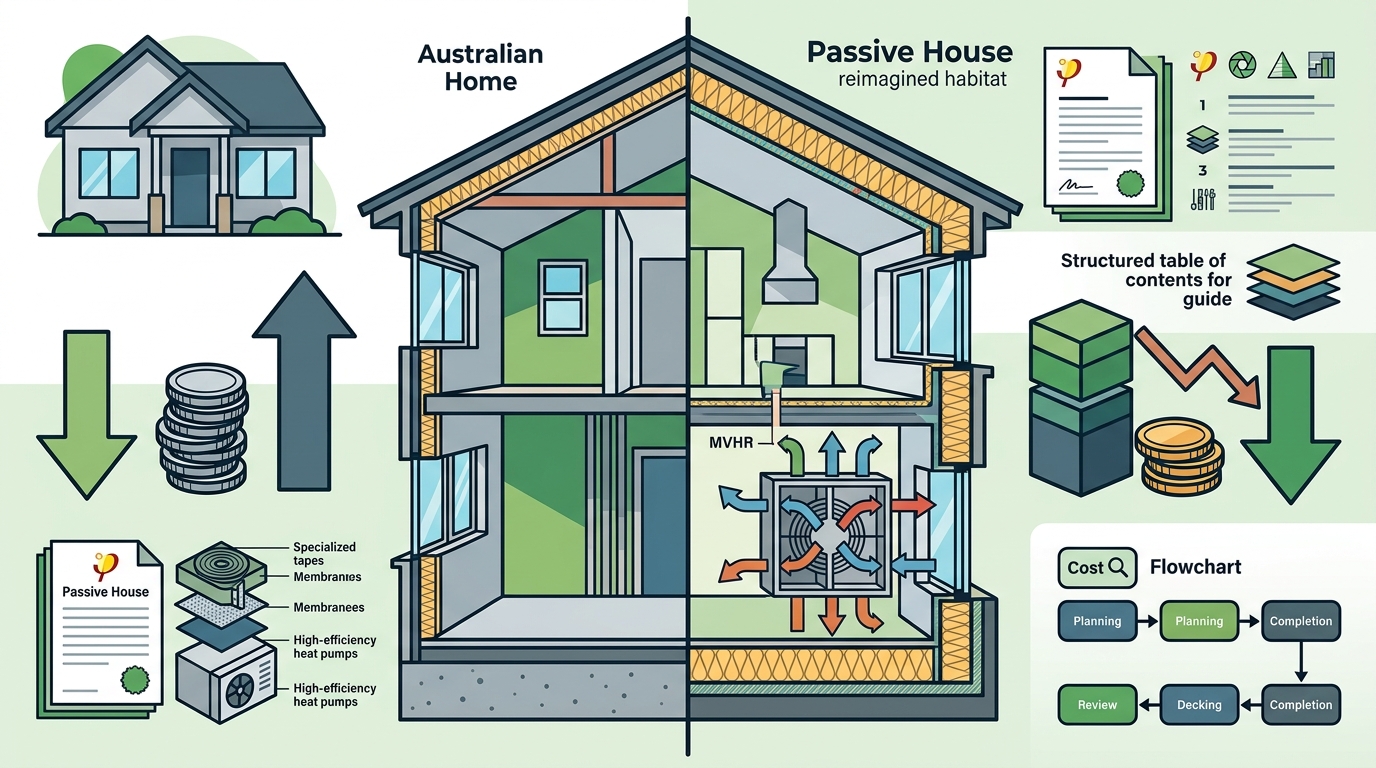
Insulation levels in Passive House designs are substantially higher than the minimum code requirements. This includes thick insulation in walls, roofs, and floors. Furthermore, the construction must include an airtight membrane. This is a continuous layer that prevents uncontrolled air leakage. In standard builds, air leaks are often overlooked or addressed with basic sealing. In Passive House, airtightness is a critical design element that requires careful detailing and quality control during construction.
Energy Bill Savings
The financial argument for Passive House is strongest when looking at long-term operational costs. A standard 6-star home in Australia still requires significant energy for heating and cooling. In contrast, a Passive House is designed to be nearly energy neutral. This means the energy required to heat and cool the home is minimal.
Homeowners of Passive House buildings often report energy bills that are a fraction of what they expected. For a typical family home, this can translate to savings of several thousand dollars per year. Over the lifespan of the home, these savings can be substantial. Additionally, because the home is so efficient, you may require a smaller heating and cooling system, which further reduces both upfront equipment costs and ongoing maintenance.
Upfront Cost Premium
When comparing the upfront cost of a Passive House to a standard 6-star home, the premium is usually in the range of 5% to 15%. This percentage can vary based on the complexity of the design, the location, and the specific materials chosen. It is important to note that this premium is not just for